


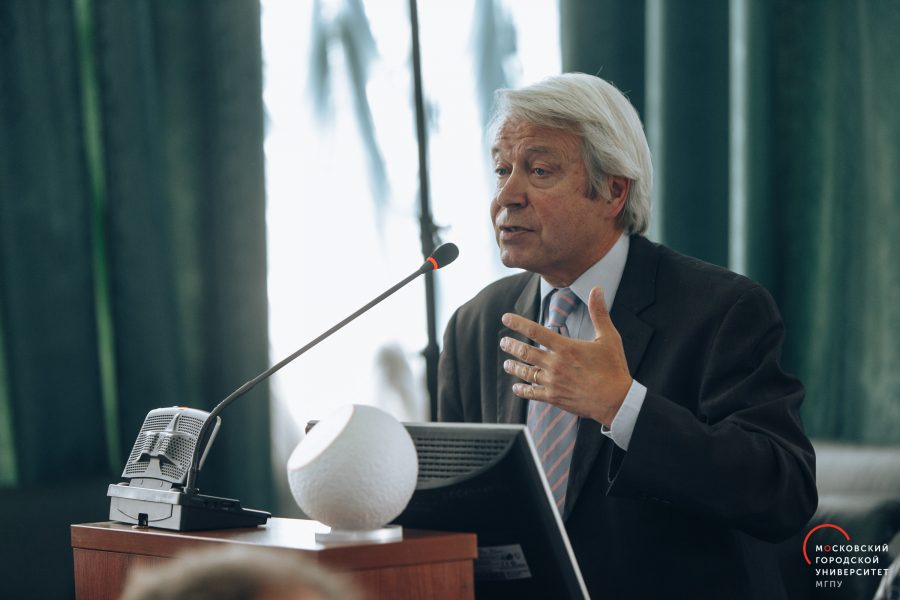
Prof. Dr. Jan De Groof
President UMEC-WUCT
(Conclusion of the Assembly 13 novembre 2022)
I’m both humbled and proud to be enabled to be at your service as the Chair of the World Union of Catholic Teachers and to have the privilege to be the successor of Guy Bourdeaud’hui. Especially in a disruptive time with major challenges in all our societies, worldwide. Teachers take the lead and own the critical capacity to cope with the major targets in society: Sustainability, Freedom and Justice, and to deliver the appropriate responses to the multiple crisis of this and next decades. The future of Education will depend on… Teachers! May I start with a few stories. Who were the very first protesters at the Tahrir Square in Cairo, Egypt: students, parents and teachers, claiming: ‘Good education and… teachers’ ! A similar scenario emerged at the Maidan Square in Kiev, in Kinshasa (DRC) or elsewhere. I had the opportunity to often meet students in Bagdad and South-Africa, and elsewhere. What did they claim first vis-à-vis the Government: ‘Education in Freedom – Equity and Dignity through Education’, and excellent teachers. I met students a fortnight ago in Budapest: they are protesting in favor of higher salaries for their teachers… ‘Education’ was qualified by the US landmark decision ‘Brown versus Board of Education’ as ‘probably the most crucial State responsibility’. ‘Education’, according to some ‘Barometers’ and polls. is the first concern of parents, together with poverty, unemployment and climate change. The most reliable international reports ranked as major concerns for the today education system: reducing the inequality gap on education opportunities and, secondly ‘the improvement of teacher training and status’… !
Mais quelles sont les conséquences concrètes que les gouvernements en déduisent ? Et pourtant, en France, le ‘Baromètre’ scientifique ‘Opinion Ways’ dresse chaque année le portrait d’une jeunesse fragilisée par la succession des crises, mais qui voit des motifs d’espoir pour leur avenir, notamment dans la famille et dans l’école. Les résultats étaient publiés la semaine passée. Les jeunes perçoivent la famille comme ‘un lieu de soutien et de conseils en cas de difficultés. Le foyer familial demeure le refuge évident, le lieu de la première solidarité !’ Plus surprenant: la confiance dans le système éducatif reste stable et augmente. ‘Seule l’école paraît capable de donner aux jeunes, notamment moins favorisés, des clés pour réussir’. 2 Cette conclusion pourrait donner des ailes à l’UMEC ! Quel est le schéma de mon intervention ? Trois étappes : – Ma lecture personnelle du noyau dur de l’engagement d’enseignant catholique ; – L’agenda des politiques d’éducation ; – Le rôle des catholiques dans le domaine de l’éducation. Permettez-moi à exprimer d’abord ce que je ressens comme l’essentiel de la mission, de la vocation de l’enseignant catholique. (cfr. Xavier Dufour, Enseignant et chrétien. Une vocation, Editions Emmanuel, Paris. 2021) L’éducation suppose que les enseignants invitent les élèves à « s’ouvrir au mystère des choses »,. L’enseignant éveille chez ses élèves le désir d’apprendre et la joie de se donner -, mais un mystère souvent ignoré est leur propre « aventure éducative » dans le cadre scolaire. ‘Enseigner’ est un acte, « le cœur battant de la vie scolaire ». Vivre en catholique ou chrétien est aussi un acte. Ces deux actes expriment une seule vocation. Qui dit ‘vocation’, dit réponse à un appel : on n’entre pas dans ce métier, on n’y réussit pas sans avoir perçu une voix qui y invite, souvent celle des enfants et des jeunes ou d’un autre enseignant admiré. Il y a toute une bibliothèque écrite sur les différentes significations de l’acte enseignement. Et l’éducation d’inspiration chrétienne y ajoute une perspective toute particulière : elle voit en chaque enfant une image du Christ, aussi voilée soit-elle parfois. Laisse-moi, en quelques mots, focaliser sur trois registres : enseigner, éduquer, évangéliser. ‘Enseigner’ : former l’intelligence d’une personne en stimulant en elle l’amour de la vérité : pas d’abord par l’acquisition des compétences directement utiles à la société, mais en aiguisant l’attention de l’élève aux vérités des domaines particuliers. « L’élève est celui qui doit s’élever, grandir.» ‘Eduquer’ : susciter et fortifier la liberté d’un enfant ou d’un jeune. L’éducateur l’appelle à grandir, d’abord dans une relation d’autorité, mais progressivement il ‘édifiera’ l’enfant, en considérant l’enfant dans toutes ses dimensions (intellectuelle, spirituelle, morale, sociale, physique, …). C’est pourquoi on ne peut pas séparer l’instruction et éducation. « L’instituteur est celui qui institue, invite à une stature nouvelle. » ‘Evangéliser’ : introduire un jeune à la vie spirituelle comme à la dimension suprême de la liberté et à stimuler une culture religieuse. Le philosophe décrit comment un professeur « tremble certains jours en songeant à la confiance des parents qui lui confient leur bien le plus précieux… » (cfr. Xavier Dufour, ibidem). Réfléchir à l’éducation et à l’instruction, c’est réfléchir à notre condition d’homme dans une société donnée, à ce qui vaut d’être transmis d’une génération à l’autre pour que se poursuive l’aventure humaine. Être un enseignant chrétien apporte un fondement et un horizon à toute la mission éducative et peut la transfigurer de l’intérieur. Ça vaut aussi bien pour l’enseignement public. Bien sûr bien d’initiatives sont pas possible, comme dans l’enseignement confessionnel, (où des familles espèrent trouver un cadre évangélique porteur, mais parmi les enseignant chrétiens qui m’ont le plus marqué figurent aussi des professeurs de l’enseignement public, même si le contexte oblige à des formes implicites de témoignage. Certes, la compétence disciplinaire est nécessaire aux enseignants et professeurs, comme est précieuse aussi une vraie culture générale pour tout enseignant, de l’école à l’université. Le goût et l’enthousiasme de transmettre, et l’attention accordée à chaque élève et le sens de la justice 3 dans la relation d’‘autorité’. (Cfr. Chr Conturie, Heureux les enseignants, Editions Salvator, Paris, 2018). Je conclus sur ce chapitre. ‘Enseigner’ reste, avant tout, une vocation. Les enjeux de la relation éducative dépassent ceux d’une profession ordinaire. C’est une réponse à quelque chose d’unique, et ce qui touche de manière directe à la dignité des personnes, à leur croissance et leur promotion. L’accompagnement d’un enfant, d’un jeune, dans le déploiement intégral de ses potentialités, intellectuelles, morales et spirituelles, apparaît comme une tâche singulière et sacrée. Je peux citer une pédagogue hors pair : « L’éducation est une mission, car vous touchez des âmes et, par vous, elles seront plus proches ou plus loin de la vérité, du bonheur, de Dieu. » Une nation se dit elle-même dans sa manière d’éduquer. L’éducation engage l’avenir de la nation. « Une société qui n’enseigne pas est une société qui ne s’aime pas, qui ne s’estime pas », comme disait Charles Peguy. Une garantie vitale pour la réussite du système éducatif reste le pluralisme et la diversité, caractéristique pour le régime démocratique et le respect de l’identité des citoyens.
I spent a huge part of my academic and societal engagement to the promotion of ‘Freedom of Education’, – often a precondition for vivid pluralism in a country and for democracy, indeed. Catholic schools (and universities) ensure a Christian presence in modern society, creating – as noted by ‘Gravissimum Educationis’ , a ‘special atmosphere in the school community animated by the spirit of the Gospel’, they help people to become qualified, also at a human level, they favor social integration in our societies characterized by drop-out, deep inequalities and conflicts, they are intended to increase social responsibility, civic commitment, research and innovation, with a view to the development, both material and spiritual, of the country in which they operate. The presence of Catholic schools is justified not on the basis of a tradition, but as a response to today’s challenges and problems, not competing but collaborating with the State education policy. The responsibility for the catholic school is entrusted, in many cases, to lay people, cooperating with religious personnel. (cfr. New Educational Horizons, edited by I Florin, A Paletta, Chr Bezzina, J De Groof, Angelo Vincenzo Zani) It remains vital that the secular staff know the charism of the founder, participate in school’s mission, and are given clear roles and responsibilities, especially in countries with a growing secularization, the breeding ground of a spiritual poverty, or in the countries where the public expression of catholic faith is hindered. Taking into account that the social and cultural context has changed profoundly since ‘Gravissimum Educationis’, the presence and service of the catholic school need to be redefined in contemporary terms. It is not an option to, as wrote Pope Francis “take refuge in our own world” but rather to foster interreligious and intercultural dialogue. The experience of Catholic institutions have shown an ability to meet, respect and value diverse cultures, building bridges between cultures and religions. But ‘dialogue’ requires a critical knowledge of the own identity. The document of the Congregation for Catholic Education, Educating Today and Tomorrow, contains many suggestions for the development and review of the ethos and character of the Catholic school. I had the privilege to be involved in his drafting process at the occasion of the fiftieth anniversary of ‘Gravissimum Educationis’. But there are also several inspiring guidelines published by national catholic authorities. Catholic schools can ‘make the difference’ through the curriculum, teaching methods and didactics, the ‘what’, ‘why’ and ‘how’ question, the close reference to families and communities, 4 but also through rigorous initial and life-long learning, including faith formation and spiritual leadership. Improving schools are those that invest in the development of their staff, sharing best practices. Quality, innovation, inclusion of education depend on teachers engagement and ability in the implementation of school education plans and mission. Je conclus. UMEC-WUCT est ‘unique’. Yes, we are Catholic, also according to the etymology: ‘universal, focus on the whole’: “KATA HOLOS”. En même temps: UMEC-WUCT va mettre plus l’accent sur les régions. May I refer to the word of Pope Francis: “The universal church lives in and consists of subchurches, just as those local churches live and flourish in and out of the universal church. If, however, they are separated of the universal church, they weaken and die out. Hence the need to keep alive the communion with the whole body which is the Church.” The local church and the world church are thus connected to each other and keep each other alive. From the universal connection oxygen can come, inspiration. The connection makes us stronger, not weaker. Ça vaut aussi pour UMEC-WUCT… ! In addition to this worldwide connection, there is the connection with Rome, which characterizes Roman Catholics. Rome is effectively the beating heart of that universal church, where Africans, Latin-Americans, Asians and Europeans meet, exchange and at the same time show each other the same and a different face of Catholic faith and commitment. Essayons de faire de sorte qu’UMEC-WUCT réponde à cette ‘Catholicité’ : la connexion entre l’union et la diversité régionale et continentale.
No responses yet